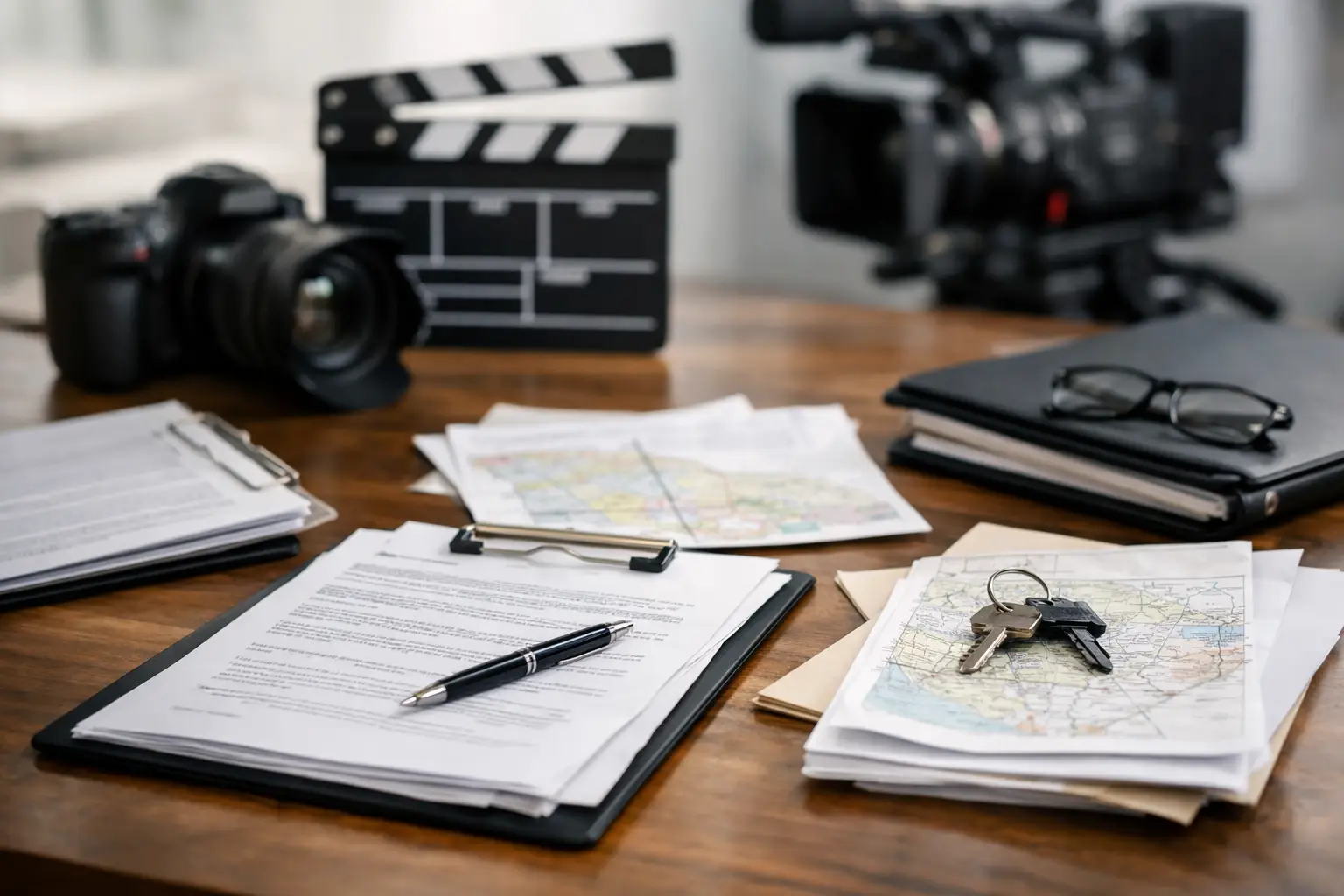
A shoot can fall apart long before the first setup if the paperwork is wrong. When producers ask what documents are needed for filming, they are usually trying to avoid the same problems: delayed gear clearance, denied access to locations, permit issues, insurance gaps, or a rebate that becomes harder to claim after wrap.
The short answer is that there is no single universal packet. The documents you need depend on where you are filming, what you are filming, how large the crew is, what gear is entering the country, whether minors, drones, vehicles, weapons, or public spaces are involved, and whether you plan to apply for local incentives. That said, most international productions need the same core categories of paperwork in place before cameras roll.
What documents are needed for filming in most productions?
At a practical level, filming documents fall into five groups: company and crew identification, permits and authorizations, customs and import paperwork, insurance and risk documents, and commercial or legal agreements. If even one of those groups is incomplete, the production can move from efficient to expensive very quickly.
For an overseas producer coming into Panama or any other foreign territory, the first layer is basic corporate and project documentation. Local authorities, property owners, customs officials, and film offices often want to see who the production company is, who is responsible on the ground, what is being filmed, and on what dates. That usually starts with a production company registration document, passport copies for key foreign crew, a project synopsis or treatment, a shooting schedule, a call sheet framework, and a local point of contact.
These may sound simple, but they matter because permits are rarely issued against vague plans. If the municipality, ministry, or private venue does not know the scope of the activity, they cannot assess whether traffic control, security, environmental review, or special conditions are required.
Permits and authorizations
When people think about what documents are needed for filming, permits are usually the first thing that comes to mind. They should be. Permits are the documents most likely to stop a shoot if they are missing.
The exact permit structure depends on the location and the production type. A small branded content shoot on private property may only need an owner authorization and standard insurance. A commercial with road control, aerial work, generators, special effects, or nighttime activity in public areas can trigger a much broader permit package.
Public location permits
If you are filming in streets, parks, sidewalks, beaches, historic districts, or other government-controlled spaces, you will typically need a location permit or municipal authorization. In some cases, separate approvals may be required from a city office, a tourism or culture authority, a traffic agency, or a police unit.
The supporting documents often include a shooting schedule, production description, equipment list, traffic impact plan, crew size, and vehicle list. If there is any public interruption, authorities may also request a safety plan and proof of insurance.
Private property permissions
Private locations are often faster to secure, but they still require paperwork. At minimum, that usually means a location agreement signed by the owner or authorized representative. The agreement should clearly state dates, access hours, fees, use of power, parking terms, restoration obligations, and any restrictions on stunts, smoke, noise, or set dressing.
A casual email approval is rarely enough for a serious production. If damage occurs or the owner later disputes usage, informal permission does not give much protection.
Specialty permits
Some productions need extra approvals beyond the base filming permit. Drone filming often requires operator credentials, aircraft registration, flight plans, and civil aviation clearance. Scenes involving firearms, prop weapons, pyrotechnics, marine activity, animals, or minors can trigger additional authorizations, notices, or specialist documentation.
This is where local knowledge matters. The issue is not just getting a permit. It is knowing which agency actually has jurisdiction and how early those requests need to be filed.
Customs paperwork for gear and production imports
For international productions, customs is where paperwork becomes operational. If cameras, lenses, lighting, grip, audio gear, wardrobe, props, or production technology are entering the country, you need a clean import file. Otherwise, gear can be delayed at the airport or port, held for clarification, or assessed in ways that affect budget and schedule.
A standard customs package usually includes a detailed equipment list with serial numbers, values, and ownership information. Depending on the territory and the shipment method, you may also need a temporary import document, airway bill or cargo reference, commercial invoice, packing list, and a letter explaining the purpose and duration of the import.
The same applies to specialty items. Drones, wireless systems, batteries, specialty rigs, and high-value technical packages often receive more scrutiny than a small camera kit. Productions sometimes assume that a carnet or freight booking solves everything. It helps, but only if the documentation matches what actually arrives.
If gear is rented locally, the import layer becomes lighter, which is one reason many foreign producers use a local service partner. Reducing imported equipment can reduce customs exposure, speed up prep, and simplify insurance coordination.
Insurance and risk documents
Insurance is not a formality. It is often a precondition for permits, location access, vendor bookings, and talent agreements. Most productions should expect to present a certificate of insurance that reflects the nature of the shoot and names the relevant parties where required.
That can include general liability, workers’ compensation or local labor coverage, auto coverage for production vehicles, equipment insurance, and in some cases errors and omissions or special event coverage. For larger shoots, authorities or property owners may ask to be added as additional insureds.
Alongside insurance, some productions are asked for a risk assessment, health and safety plan, emergency contact sheet, and medic or security plan. These documents become more important when the shoot includes water work, remote terrain, heavy equipment, crowd scenes, weather exposure, or long travel days.
A low-impact docu-follow shoot will not be reviewed the same way as a vehicle commercial or action sequence. Paperwork should reflect the actual risk profile of the production, not just a generic template.
Contracts, releases, and legal records
Filming documents are not only about authorities. They also protect the production’s ability to use what it captures.
Talent releases, appearance releases, crew deal memos, vendor agreements, music licenses, and location releases all belong in the production file. If branded products, artwork, signage, or private individuals appear on camera, rights and clearances need to be considered early, not during post.
For documentary, reality, and factual productions, release strategy is especially important. A public-space shoot may still require individual releases depending on how prominently people appear and how the footage will be used. Editorial context, commercial usage, and platform distribution all affect the threshold for what should be cleared.
For foreign producers operating in Panama, locally compliant service agreements, labor arrangements, and vendor records also matter. They help establish a clear chain of responsibility and support cleaner accounting if the production plans to pursue incentives or formal cost reporting.
Documents needed for filming incentives and rebates
If the production is seeking a rebate, the answer to what documents are needed for filming becomes broader. Incentive systems usually require more than permits and contracts. They demand records.
You may need a local production services agreement, a full budget, proof of qualifying local spend, vendor invoices, payroll records, bank transfer confirmations, tax documentation, and a final audited cost report or equivalent review package. Some programs also require project registration before principal photography begins.
This is where many productions lose value. The shoot itself may run well, but if spending records are inconsistent, vendors are not properly documented, or qualifying and non-qualifying costs are mixed together, rebate recovery becomes slower or smaller than expected.
Good paperwork for incentives starts in prep, not in accounting cleanup after wrap.
The real variable is jurisdiction
Every country has its own process, and within a country, different municipalities or agencies may ask for different supporting documents. Panama is production-friendly, but that does not mean every permit is automatic or every public authority works on the same timeline. Beach access, urban filming, aviation activity, customs, and protected areas each come with their own rules.
That is why experienced producers do not just ask what documents are needed for filming in theory. They ask what is required for this shoot, in this district, on these dates, with this footprint. Those details change the document list in practical ways.
A lean interview crew with two cameras can move quickly. A commercial unit blocking traffic, importing gear, and applying for a rebate needs a more structured document build. Neither approach is wrong. They simply require different planning.
How to avoid document delays
The safest approach is to build your paperwork in parallel with your production plan. As soon as locations, dates, gear strategy, and shooting footprint start to solidify, the permit path should be mapped at the same time.
That means confirming which permits apply, who issues them, what support documents are needed, what lead times are realistic, and which items depend on one another. Customs paperwork should match the final gear manifest. Insurance should reflect actual activities. Contracts should be signed before access or services begin, not after.
For international shoots, a local production partner can compress that process considerably. A company like 40 Grados Producciones can coordinate permits, local compliance, customs preparation, crew support, and production documentation as one operating track instead of treating them as separate problems.
The strongest productions are not the ones with the most paperwork. They are the ones where the paperwork matches the reality of the shoot, satisfies local requirements, and supports the schedule instead of fighting it.
If you are planning to film abroad, treat documentation as part of production design. Done early and done correctly, it protects the budget, keeps the set moving, and gives the creative team room to focus on the work that actually ends up on screen.