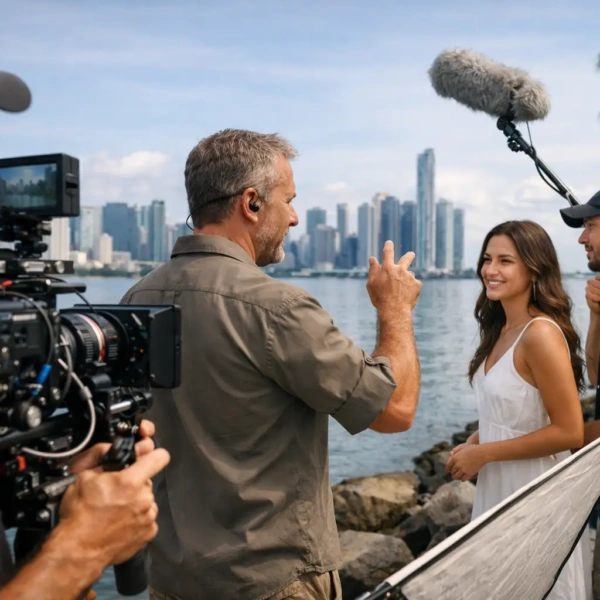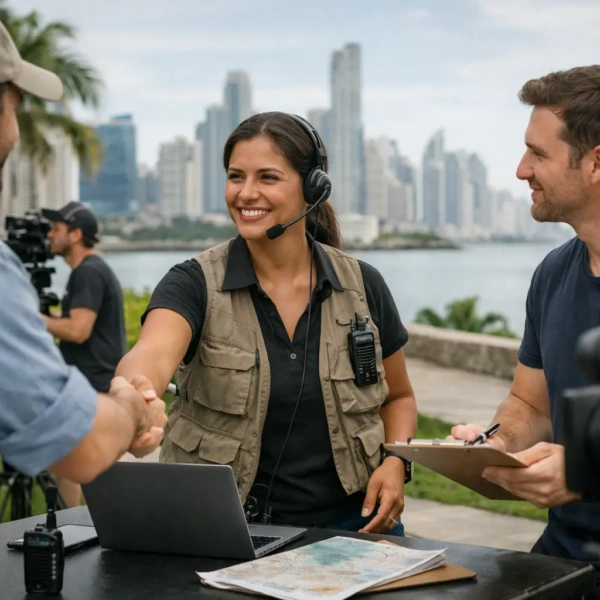


A Panama shoot can look simple on a deck: a compact flight from Miami, multiple climates within driving distance, competitive crew rates, and a 25% cash rebate incentive. The operational reality is less forgiving. When weighing production services vs in house team, the real decision is not whether you want control. It is how to maintain control without carrying the cost, risk, and local learning curve of building an operation from abroad.
For an international producer, the right answer depends on the project’s scale, duration, technical demands, and familiarity with Panama. A feature with a long prep period and recurring regional work may justify a deeper internal footprint. A commercial, reality episode, travel series, or fast-turn branded shoot often benefits from a local production partner that is already connected to the crews, suppliers, locations, and authorities needed to move quickly.
Production Services vs In-House Team: What Changes on the Ground
An in-house team gives a production company direct ownership over its process. Your producers, coordinators, accountants, and department heads operate under one internal culture and follow established approval lines. For companies producing continuously in the same territory, that consistency has value.
But an in-house structure does not automatically create local capability. A producer arriving with a trusted core team may still need to source bilingual coordinators, camera assistants, drivers, security, fixers, casting support, equipment vendors, medical services, marine operators, and location contacts. They must also understand permit lead times, labor practices, customs procedures, insurance requirements, and the conditions attached to a filming incentive.
Production services fill that gap. A qualified local service company works as the on-the-ground production department, while the visiting producer retains creative and budget authority. The service partner does not replace the client’s team. It gives that team a working local infrastructure from the first scout through wrap.
That distinction matters most when time is limited. A location that is visually perfect is not useful if access approvals, unit parking, weather contingencies, power, transport, or neighborhood coordination have not been resolved. Local production knowledge turns a promising location into a shootable one.
Control Is Not the Same as Doing Everything Internally
Some producers assume that hiring production services means giving up control. In a well-managed structure, the opposite can be true. The client sets the creative brief, schedule priorities, production standards, reporting requirements, and spending approvals. The local team executes against those parameters while flagging realities that may not be visible from another market.
For example, a line producer may request a beach location, city coverage, rainforest footage, and a controlled interior within three shooting days. An in-house team can manage this if it already knows the territory. If it does not, the time required to validate routes, permits, crew calls, equipment movement, and alternate weather plans can consume the savings of self-managing the job.
A production service partner provides practical intelligence before those issues become expensive. That includes advising when a location requires more lead time, when a smaller unit is more efficient, which local crew configuration fits the schedule, and where a requested production approach creates unnecessary exposure.
The best service relationship is transparent, not opaque. Producers should expect clear estimates, local vendor options, daily cost reporting, documented approvals, and one accountable point of contact. Local expertise should make the operation easier to audit, not harder.
The Cost Question: Compare Total Cost, Not Service Fees
An internal team can appear less expensive because payroll and overhead may already be committed. That calculation is incomplete when a production is entering a country where it does not have established vendor relationships or operational systems.
The relevant comparison includes travel and accommodation for the visiting team, prep days spent building local knowledge, time lost on incorrect assumptions, equipment freight, customs exposure, local hiring, permit administration, transport inefficiencies, and contingency costs. A production service fee should be evaluated against the cost of solving all of those tasks independently.
Panama offers a strong value proposition for international productions, but savings come from planning the right structure. A service company can help align the project with local crew availability, equipment options, location clusters, and production schedules that reduce unnecessary moves. It can also identify whether the production may qualify for Panama’s 25% cash rebate incentive and what documentation, spending thresholds, and compliance steps need to be addressed early.
The rebate should never be treated as an afterthought. Incentive planning affects budgeting, contracting, recordkeeping, and payment procedures. An internal production manager may be highly experienced in another jurisdiction but still need local support to build a compliant process in Panama.
When an In-House Team Makes Sense
Building a stronger internal presence can be the right move when a company has a high volume of recurring work in Panama or Central America. This may include a network with an ongoing series, a studio managing a long-term slate, or a brand producing repeated regional campaigns with similar technical and staffing needs.
An in-house approach is also useful when the project depends on proprietary workflows, specialized technology, or a large group of department heads who must work together over an extended period. In those situations, a traveling core team can protect continuity across episodes or units.
Even then, local production services remain valuable. The model does not have to be either-or. Many successful international productions bring their key creative and technical leadership while partnering with a Panama-based service team for permits, local crew, locations, payroll, equipment, vehicles, legal coordination, and government-facing requirements.
This hybrid structure protects the production’s established working methods without asking its team to become experts in a new country overnight.
When Production Services Are the Better Choice
Production services are usually the more efficient option for projects with limited prep, short shooting windows, unfamiliar locations, or multiple moving parts. Commercial teams often need this support because agency approvals can shift quickly and each day on location carries a high cost. Reality and documentary productions benefit because access, contributors, travel, and changing story conditions demand constant local coordination.
Feature and television productions also gain from a local partner when they need a full service package rather than a single fixer. A production may require location scouting, permits, casting assistance, crew hiring, production design sourcing, camera and grip support, transport, accommodation, catering, security, and accounting. Managing each of those vendors separately from overseas creates fragmentation at exactly the point where production needs one reliable chain of command.
At 40 Grados Producciones, the role is to give visiting productions a one-stop local production base in Panama. That means translating a creative plan into permits, crews, locations, logistics, and compliant execution, while keeping the international producer informed and in control.
Questions to Settle Before You Choose
Before selecting a model, producers should pressure-test the plan with direct operational questions. Who is responsible for permits and how early must applications begin? Who carries local vendor agreements and confirms insurance requirements? Who can replace a crew member, vehicle, or location on short notice? Who manages customs coordination if equipment is brought into the country? Who maintains the records required for incentive eligibility?
If the answer to those questions is a visiting producer who has not worked in Panama before, production services are not an extra layer. They are risk management.
Also consider the cost of local credibility. Location owners, municipal offices, crews, and suppliers respond differently when communication comes through a team they know and trust. That relationship capital cannot be assembled in a few prep calls. It is built through completed shoots, accurate payments, realistic schedules, and consistent professional conduct.
Build the Team Around the Production, Not the Org Chart
The strongest choice is the one that gives the production enough authority, local access, and financial visibility to deliver the work without avoidable friction. For some companies, that means expanding an internal team. For many international shoots in Panama, it means bringing a trusted core team and pairing it with an experienced local production service partner.
A good production structure should make difficult days manageable: a permit change, a weather hold, a last-minute location request, an equipment need, or an incentive question. Choose the team that can answer those problems locally, quickly, and with the production’s budget and schedule in view.