
A location decision can save a schedule or quietly drain it. When producers compare Panama versus Costa Rica filming, the real question is not which country is more beautiful. Both deliver tropical terrain, coastline, rainforest, and strong visual value. The question is which market gives your production the best mix of access, control, incentive value, crew support, and operational speed.
For international shoots, that decision usually comes down to more than scenery. Permits, customs, road access, local infrastructure, weather patterns, urban versatility, and the quality of on-the-ground support all affect the final cost of a production. If you are weighing Panama against Costa Rica for a feature, commercial, reality series, travel production, or branded shoot, the smartest comparison is practical.
Panama versus Costa Rica filming: what matters most
Both countries are established filming destinations in Central America, but they serve productions in different ways. Costa Rica has a long-standing reputation for eco-tourism visuals and natural beauty. Panama combines tropical locations with a broader production base, modern urban environments, stronger connectivity, and a financial incentive that can materially change your budget.
That difference matters if you are trying to build an efficient plan rather than just secure a postcard backdrop. A jungle sequence, beach campaign, or rainforest reality setup may work in either market. But if your schedule also requires city exteriors, port access, upscale neighborhoods, highways, aerial variety, colonial architecture, and easy movement between distinct looks, Panama tends to offer more range within tighter production windows.
Location variety and visual flexibility
Costa Rica is often the first name that comes up for green landscapes, wildlife-driven content, surf beaches, and eco-luxury settings. It is a strong option when the creative brief is centered almost entirely on nature and sustainability-oriented imagery.
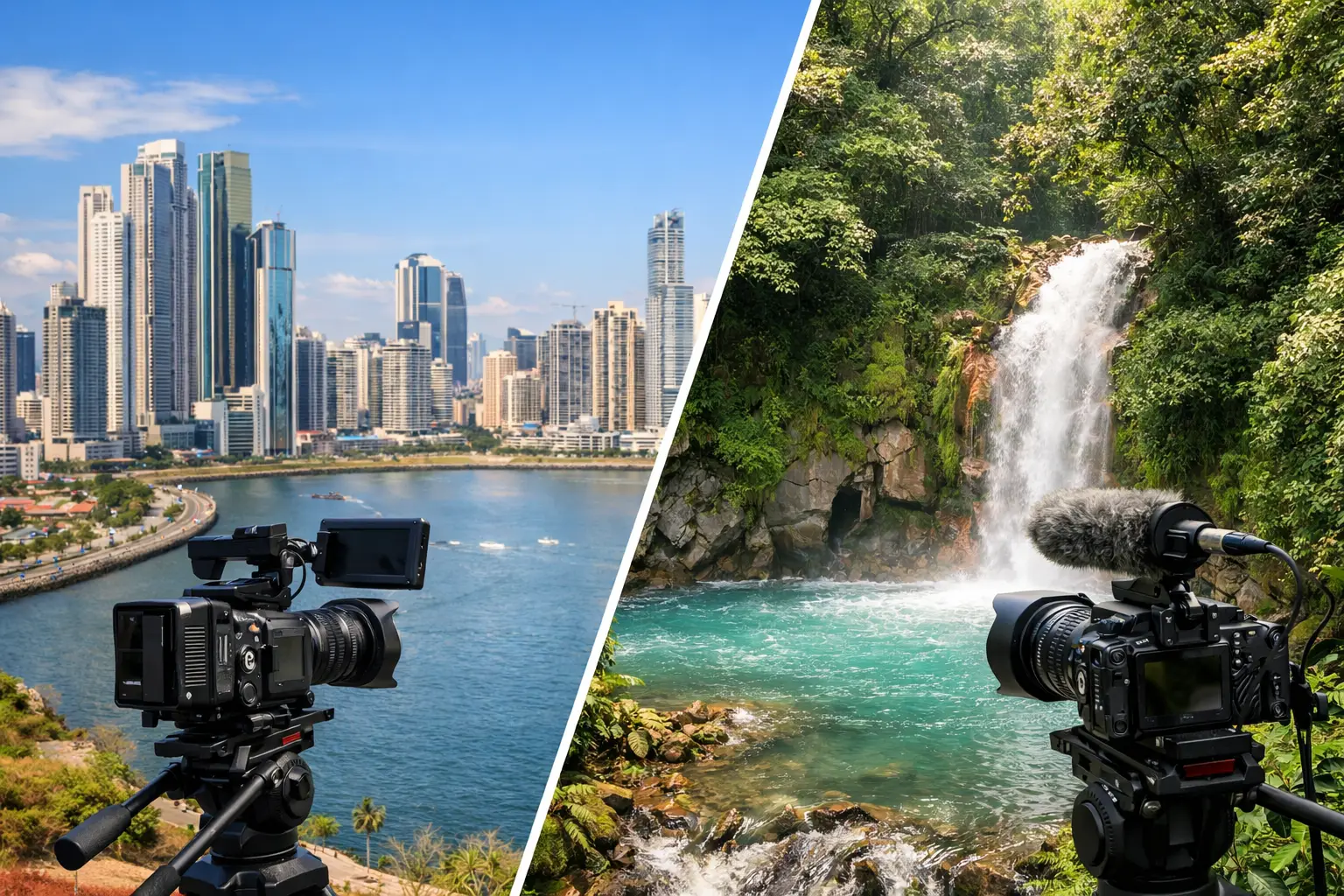
Panama, however, often gives producers more visual range in a smaller operating radius. You can move from modern skyline shots to Casco-style historic streets, Caribbean beaches, Pacific coastlines, rainforests, mountain areas, industrial zones, ports, islands, and high-end residential environments without treating each move as a separate logistical campaign. For productions balancing multiple visual needs, that concentration can reduce company moves, lodging complexity, and transport costs.
This is where Panama versus Costa Rica filming becomes less about aesthetics and more about shot efficiency. If your boards include both tropical and metropolitan scenes, Panama can cover more pages without forcing a split-country strategy.
Urban production value
One of Panama’s clearest advantages is urban scale. Panama City offers a modern skyline, financial district visuals, upscale hotels, highways, rooftop locations, marinas, and a polished international look that is difficult to match elsewhere in the region. That makes Panama especially effective for commercials, branded content, scripted work, and unscripted productions that need both tropical access and a credible global-city backdrop.
Costa Rica has attractive cities and towns, but it is generally chosen for its natural settings rather than for a metropolitan production profile. If your project needs a city that can play as Latin America, Miami-adjacent, international business, or premium lifestyle, Panama has a stronger position.
Incentives and budget impact
For many producers, this is where the comparison gets serious. Panama offers a 25% cash rebate incentive, and that can significantly improve budget efficiency when a project qualifies and is structured correctly. On the right production, that rebate is not a minor perk. It can influence location viability, stretch shooting days, and improve the overall production value on screen.
Costa Rica may still make financial sense for some projects, especially if the scope is compact and the location needs are highly specific. But when producers evaluate total spend alongside rebate potential, Panama often becomes the more strategic option.
Of course, incentives are only useful if the local process is clear, compliant, and well managed. Missteps in paperwork, spend tracking, or local execution can eat into the value quickly. That is why experienced local production support matters as much as the incentive itself.
Crew, vendors, and production infrastructure
A beautiful country is not automatically an easy production base. The strength of local crew, equipment access, vendor reliability, and day-to-day coordination usually determines whether a shoot runs cleanly.
Panama has a strong advantage in being a practical operating hub for international productions. It offers experienced local crews, bilingual support, equipment solutions, transportation coordination, permitting assistance, legal guidance, and smoother integration for overseas teams that need a one-stop production setup. For line producers and production managers, that means fewer variables and more control.
Costa Rica has skilled professionals and production experience as well, but project requirements may sometimes demand more advance planning around sourcing, movement, or technical support depending on the scale and type of shoot. The gap is not absolute. It depends on what you are producing. Still, Panama tends to be better positioned for productions that need broad service support under one local framework.
Speed to execution
International producers rarely have the luxury of loose timelines. Agency work shifts fast. Series schedules compress. Talent windows move. Brand approvals arrive late. In those conditions, execution speed matters.
Panama benefits from strong international air connectivity, a business-oriented operating environment, and a production ecosystem built to support foreign teams. That can translate into faster prep, simpler arrivals, and more predictable coordination across departments. If your production needs to move quickly from scout to permits to principal photography, that operational pace can be a deciding factor.
Permits, compliance, and local navigation
Permits are where location plans can either stay simple or become expensive. Neither Panama nor Costa Rica should be approached casually on compliance. Public locations, protected areas, drone operations, customs procedures, and municipal authorizations all require proper handling.
The difference is often in how efficiently those requirements can be managed through local expertise. Panama is well suited to international productions that want a clear support structure for permits, legal process, logistics, and local coordination. With the right local partner, producers can centralize those tasks instead of trying to build a network department by department.
That model is especially useful for productions entering the region for the first time. A fixer is helpful. A full-service local production partner is better when the shoot has real budget exposure and little room for administrative friction.
Travel, access, and moving a unit
Travel convenience should never be treated as secondary. Crew movement, gear arrivals, lodging access, and road time all affect working hours and overtime exposure.
Panama’s role as a regional business and aviation hub gives it an edge for many international teams. Direct flight access is strong, airport infrastructure is efficient, and the country is set up to receive business travelers at scale. Once on the ground, many key locations are reachable within practical production distances.
Costa Rica can absolutely deliver outstanding shoots, but some productions may face longer movement times between very specific natural environments or encounter infrastructure variables that require more buffer in the schedule. Again, it depends on the brief. If the project is built around a single coastal or jungle zone, that may not matter much. If the job demands multiple looks across limited days, it matters a lot.
Which country fits which production?
If the creative priority is pure eco-visual storytelling, wilderness immersion, surf culture, or hospitality content anchored almost entirely in nature, Costa Rica can be a strong fit. It has earned that reputation.
If the production needs a wider mix of looks, stronger urban assets, easier international access, experienced production support, and a cash rebate that improves the financial model, Panama often makes the better business case. That is particularly true for commercials, reality television, branded campaigns, music videos, docu-follow formats, and scripted work that need more than one environmental profile.
This is why Panama versus Costa Rica filming is rarely a simple beauty contest. It is a production design and logistics decision. The right answer depends on whether your priority is niche natural specificity or broader shooting efficiency.
The strategic case for Panama
For many international producers, Panama is the more versatile base. It combines tropical and urban looks, supports complex production logistics, offers competitive costs, and strengthens the budget with a 25% cash rebate. Just as important, it allows foreign teams to work through a local structure that can handle permits, scouting, crew, legal requirements, transport, and on-the-ground execution without unnecessary fragmentation.
That is the value of working with a production partner that understands both the market and the expectations of overseas clients. 40 Grados Producciones supports international shoots in Panama with end-to-end local production services designed to keep filming efficient, compliant, and cost-conscious.
If you are choosing between the two countries, start with the schedule, not the scenery. The best filming destination is the one that lets you get the shots, protect the budget, and keep the production moving.