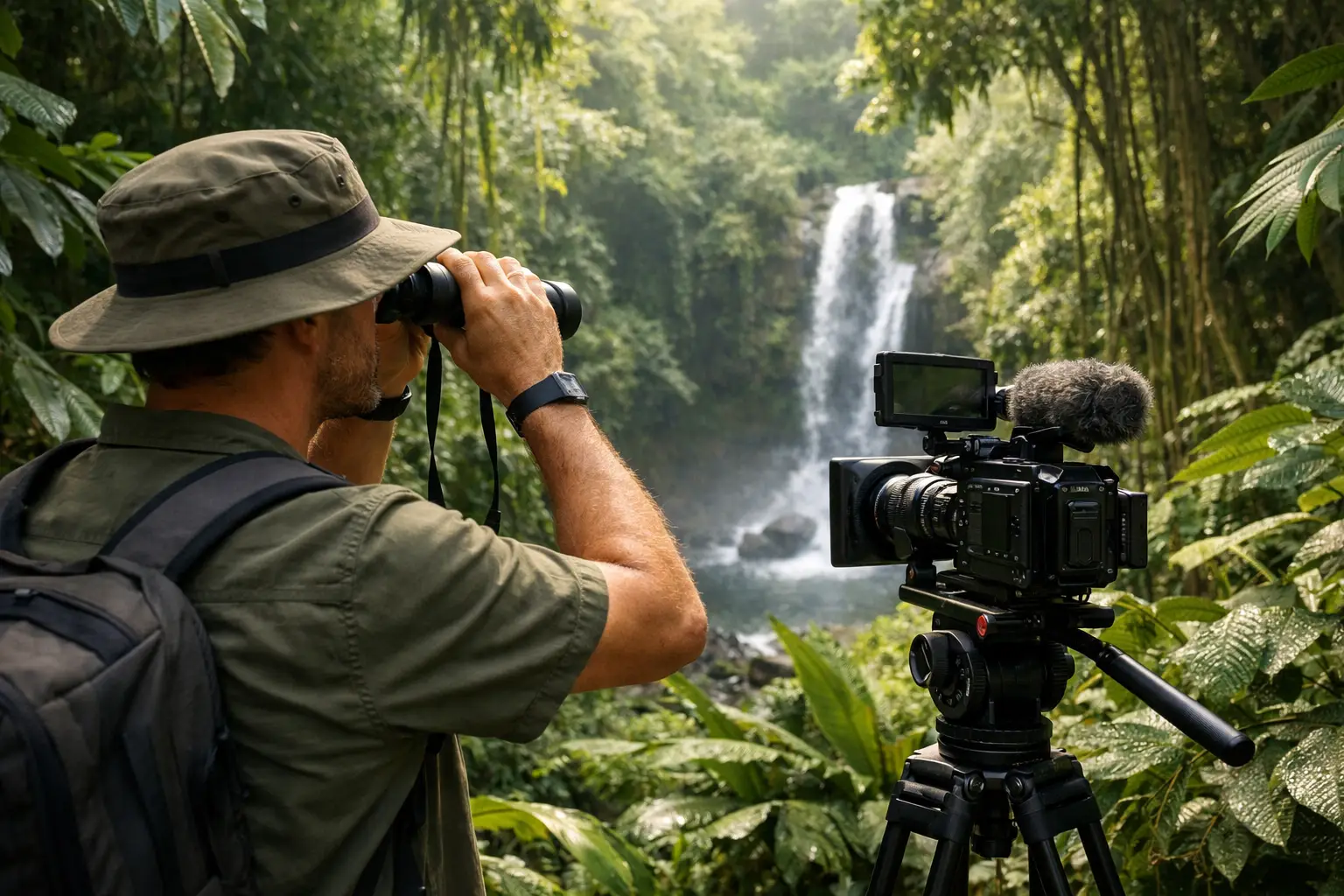
A jungle that looks perfect from a road or drone can fail the moment a camera truck, sound team, and 45-person crew need to reach it before call time. Learning how to scout jungle filming locations means looking beyond canopy, waterfalls, and cinematic mist. The real question is whether the location can support a safe, legal, controllable production day.
For international productions in Panama, jungle scouting is a production exercise, not a tourism exercise. The strongest options balance visual value with access, permitting feasibility, weather resilience, crew welfare, and the ability to move equipment without damaging the environment or the schedule.
Start With the Script, Not the Scenery
A location brief should define what the jungle must do on screen before anyone begins driving or hiking. Is the scene a deep, untouched rainforest? A chase route? A river crossing? A remote camp? A controlled dialogue scene that requires clean sound? Those are very different scouting assignments, even when the visual reference is simply “tropical jungle.”
Break the script into practical requirements: required frame direction, time of day, cast and stunt activity, picture vehicles, special effects, water work, drone use, and the expected shooting footprint. A lush trail may work for a handheld survival sequence but be unusable for a commercial with a large lighting package, wardrobe changes, client monitoring, and a full base camp.
In Panama, jungle environments can vary quickly between coastal rainforest, lowland forest, river corridors, protected areas, and more accessible secondary forest. The right choice depends on the production’s visual priorities and operational tolerance. A more remote location may deliver scale and isolation, while a site closer to established infrastructure can protect the budget and daily page count.
How to Scout Jungle Filming Locations for Production
A proper first scout should test the entire route, not only the hero frame. Start at the nearest airport, hotel zone, production office, or equipment warehouse and follow the actual transport path to the site. Record travel time at the expected call hour, identify road restrictions, and note whether rain changes the route from manageable to impassable.
At the location, walk the crew path from parking or drop-off to the proposed set. Measure the distance and elevation change. Confirm whether generators, camera carts, grip equipment, wardrobe cases, catering supplies, and emergency vehicles can get close enough to work efficiently. If equipment must be hand-carried, calculate labor, time, trail protection, and the effect on the shooting schedule before presenting the site as a viable option.
The visual scout should also happen with the sun in mind. Dense canopy creates beautiful texture, but it can produce deep contrast, green bounce, sudden shafts of direct light, and short shooting windows. Use a compass or sun-path tool, photograph the frame in multiple directions, and flag where the sun will strike talent or backlight the lens at the planned shooting time. If the scene needs continuity over several hours, determine whether overhead diffusion, negative fill, or a different orientation is realistic.
Sound deserves the same attention as picture. Jungle locations carry insect activity, birds, wind in the canopy, running water, distant roads, aircraft routes, and sometimes nearby community activity. Record ambient sound at different times of day. A dramatic waterfall may be visually ideal for a music video but impractical for scripted dialogue. The answer is not always to reject the location. It may be to plan ADR, adjust blocking, select a quieter angle, or reserve the site for non-sync shots.
Check Access Before You Promise the Location
Access is often the deciding factor on jungle shoots. A location may be only 15 miles from a city on a map, yet require a slow four-wheel-drive approach, a river crossing, or a narrow route that cannot accommodate a production truck. Scout with the correct vehicle assumptions, especially during the wet season.
Ask who controls the road, gate, trail, river landing, and parking area. Private landowners, local communities, municipal authorities, park administrators, and environmental agencies may each have a role. A site can be visually accessible but legally unavailable, or available only under conditions that affect crew size, vehicle access, hours, and construction.
Build a clear access plan around the actual production footprint. Confirm whether there is room for unit vehicles, honey wagons, generators, security, catering, and a covered holding area. If there is no suitable base camp nearby, identify the nearest alternative and calculate the transport time for cast and departments. Small inefficiencies compound quickly when every battery, lens change, meal, and bathroom break requires a trail transfer.
Treat Permits and Environmental Rules as Location Criteria
Jungle permits should be evaluated early, not after a creative team has committed to a favorite image. Panama has exceptional natural locations, including protected and environmentally sensitive areas, but those settings can require specific approvals, site supervision, insurance documentation, environmental safeguards, and lead time.
The production must understand what is allowed at each location. Restrictions may apply to drone flights, night work, amplified sound, generators, vehicles, temporary structures, vegetation clearance, open flames, smoke effects, animals, water use, and the number of people allowed on site. A location that prohibits trail alteration or vehicle entry may still work beautifully, but only if the production designs around those conditions.
A local production partner can verify jurisdiction, coordinate the required authorities, and prevent costly assumptions. This is particularly valuable when a project has multiple jungle locations with different owners or regulatory frameworks. One permit strategy rarely covers every site.
Plan for Rain, Heat, and Crew Recovery
In tropical production, weather is not a background detail. Rain can arrive quickly, change roads and trails, affect camera protection, raise river levels, and reduce safe working time. During the scout, identify covered areas for crew recovery, equipment staging, and temporary weather holds. If none exist, determine what can be brought in without violating site restrictions or creating excessive setup time.
Heat, humidity, insects, and fatigue also affect the shooting day. Evaluate where water can be stored, where the medic can operate, how quickly an injured crew member can be extracted, and whether reliable communication is available. Cellular coverage may disappear once the crew enters forest terrain, so radio plans, satellite communications, and designated check-in points may be necessary.
The site safety plan should address more than wildlife. Uneven ground, slippery roots, falling branches, flash-flood exposure, deep water, and lightning risk are often more immediate production hazards. For stunts, water work, night photography, or remote travel, bring the appropriate department heads on a technical scout rather than relying solely on stills and a location report.
Build a Scout Report That Helps Decisions Happen
A useful jungle scout report lets an executive producer or director compare options without needing to revisit every site. It should include clear photos from proposed camera positions, video of the approach and surrounding area, GPS references, access notes, estimated travel times, parking capacity, sound observations, sun direction, cellular coverage, weather risks, permit status, and local contacts.
For each location, state the production trade-off plainly. For example: exceptional primary jungle look, but two-hour 4×4 access and limited generator placement. Or: easy access and strong base camp, but intermittent road noise and less dense vegetation. Producers need a decision tool, not an overly optimistic photo gallery.
It is also smart to scout alternates. A first-choice rainforest location may become unavailable because of weather, permit timing, road conditions, or a change in scene requirements. A nearby backup with a similar canopy, trail width, or water feature can save a day that would otherwise be lost to relocation.
Schedule a Technical Scout Before Locking the Plan
Once the creative team selects a site, return with the departments that can expose production issues early: assistant directing, camera, grip and electric, sound, art, transportation, safety, special effects, and the local location team. This is where routes become load-in plans, beautiful backgrounds become camera angles, and broad access assumptions become workable call-sheet logistics.
At this stage, confirm crew movement, generator placement, cable runs, vehicle turns, base camp layout, rain cover, waste removal, and restoration requirements. If a scene includes a controlled burn, rain effect, drone operation, or any activity outside normal filming, verify approvals and safety protocols before the company arrives.
40 Grados Producciones coordinates location scouting and on-the-ground production services in Panama with the practical goal of making those decisions early, clearly, and in compliance with local requirements.
The best jungle location is not necessarily the wildest one. It is the one that gives the director the frame, gives the crew a workable day, respects the site, and gives the production enough control to deliver on schedule.