
A Panama shoot can look cost-efficient on paper and still go sideways fast if the budget is built from assumptions instead of local reality. The producers who get the best results are the ones who know how to budget Panama shoots around permits, geography, crew availability, transport time, and rebate timing – not just day rates.
Panama is attractive for good reason. You can move from urban skyline to rainforest, beaches, islands, colonial streets, and industrial zones without crossing borders. Crew depth is strong, costs are often lower than in larger production hubs, and the 25% cash rebate can materially improve the financial picture. But none of that helps if your budget treats Panama like a generic tropical location.
How to budget Panama shoots from the ground up
The cleanest way to build a Panama budget is to start with the schedule, then pressure-test every line against local production conditions. That means defining not only how many shoot days you have, but how many prep days, tech scout days, travel days, hold days, weather contingencies, and wrap days the project actually needs.
A common mistake is budgeting only for visible shooting activity. In Panama, the hidden cost drivers are usually logistics. A location that looks close on a map may require extra transport coordination, marine support, restricted access windows, or longer company moves. A day that seems simple may become more expensive once police support, municipality approvals, location control, or generator coverage are added.
If you are building a first-pass budget from abroad, separate your estimate into six working groups: development and prep, permits and legal, crew and labor, equipment and technical support, travel and accommodation, and on-the-ground logistics. That structure makes it easier to see where Panama creates savings and where local complexity needs more room.
Start with the script, not the incentive
The rebate matters, but it should not be the first number in your spreadsheet. Start with the actual production requirements. If the script needs multiple company moves, water work, aerial filming, night exteriors, or remote access, those costs need to be modeled honestly before any rebate offset is applied.
Some producers get into trouble by using the incentive to justify an underbuilt working budget. That creates stress later when real-world execution costs come in above assumptions. The better approach is to build the budget as if the production must function on its own, then evaluate how the rebate improves the final spend.
The Panama costs that move the most
Crew is usually one of the strongest value areas in Panama, but rates still depend on format, schedule intensity, bilingual requirements, and whether you need highly specialized department heads or support for a large international footprint. Commercials, branded content, reality, and scripted work all behave differently. The cheapest crew setup is not always the most efficient one if weak coordination creates overtime, delays, or duplicated roles.
Locations are another variable line. Panama offers excellent variety, but costs change based on ownership, exclusivity, control needs, and permitting path. A beach, a historic district, a government-adjacent site, and a private tower lobby may all carry very different approval timelines and management expectations. Budgeting them under a single generic location fee usually leads to revisions.
Transportation deserves more attention than many line producers give it in the first draft. Local moves can be straightforward in Panama City and still become expensive when unit vehicles, talent transport, grip trucks, marine transfers, security, or crew shuttles are layered together. If your shoot mixes city locations with remote terrain, your transport budget needs to reflect staging time as well as distance.
Equipment can be cost-effective locally, but availability depends on your dates and package needs. Standard camera, grip, electric, and production support are generally accessible, while more specialized builds may need earlier sourcing decisions or supplemental import planning. The trade-off is simple: waiting too long can reduce options and raise costs.
Permits, compliance, and legal support are not side notes
Foreign productions sometimes underbudget administrative support because it is less visible than camera or talent. That is a mistake. Permits, municipal coordination, location releases, customs planning, insurance alignment, labor considerations, and production compliance all affect whether your schedule stays intact.
In Panama, good local production management often saves money by preventing friction rather than by lowering a single line item. That is especially true on shoots with public-space filming, drone use, traffic impact, or multiple jurisdictions. You are not only paying for approvals. You are paying to avoid downtime, refusals, and last-minute rework.
How to budget Panama shoots for travel and lodging
Travel costs depend heavily on where your core team is coming from and how much of the crew you intend to travel in versus hire locally. That decision affects airfare, hotels, per diems, local transport, baggage, carnets or import handling, and the overall complexity of production support.
For many Panama shoots, the smart budget move is to travel in essential creatives and key client stakeholders while building around local crew and local services wherever possible. That reduces both direct cost and operational drag. Flying in too many roles often looks manageable in a deck and inefficient once accommodation, airport handling, transport schedules, and daily coordination are added.
Hotel strategy also matters. The lowest room rate is not always the lowest production cost. If the property is far from set, lacks crew-friendly meal timing, or creates repeated traffic delays, the savings disappear into overtime and transport. A production-ready lodging plan should be based on schedule efficiency, not just nightly rate.
Weather days and contingency are real budget lines
Panama can be highly production-friendly, but weather planning still needs discipline. If your project depends on exteriors, boats, drones, mountain access, or tightly timed natural light, contingency should be built into the schedule and the budget from day one.
This does not mean padding every estimate. It means putting reserve where the risk actually sits. A controlled interior-heavy commercial may need modest contingency. A travel campaign crossing multiple outdoor regions may need more. The stronger your local recce and scheduling logic, the more precise that contingency can be.
Building around the 25% cash rebate
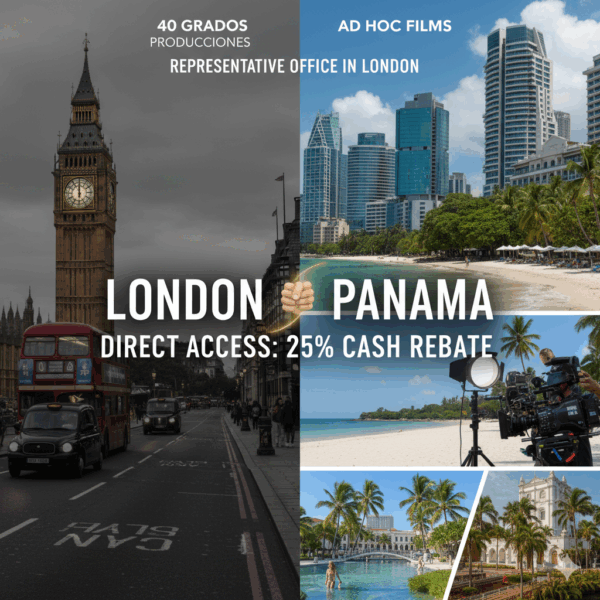
The 25% cash rebate is one of Panama’s major production advantages, and it should be part of any serious financial discussion. But it works best when handled as a strategic layer, not a marketing headline.
Your budget should identify which expenditures are likely to qualify, what documentation standards need to be maintained, and how the rebate timing affects cash flow. Those are separate questions. A cost can be eligible and still create short-term financing pressure if the production expects the rebate to behave like immediate cash.
For producers and financiers, this is where local guidance becomes practical, not promotional. The value is in structuring the spend correctly, aligning paperwork from prep through wrap, and avoiding preventable errors that weaken the claim. If the incentive is central to greenlighting the shoot, then the administrative pathway deserves line-item respect.
The fastest way to lose control of the budget
The biggest budget failures in Panama are rarely caused by one expensive surprise. They usually come from a chain of small misreads: underestimating prep, assuming permit access is automatic, booking the wrong transport setup, ignoring weather windows, importing gear that could have been sourced locally, or scheduling remote locations too tightly.
That is why experienced producers budget Panama in working scenarios, not in a single static version. A base case, a weather-adjusted case, and a location-heavy case will tell you far more than a polished top sheet with no stress test behind it.
If you want a cleaner number early, get local verification before locking the schedule. A service partner such as 40 Grados Producciones can usually spot the budget lines most likely to shift – and just as important, show where Panama can deliver real savings without compromising execution.
What a smart Panama budget actually does
A smart budget does more than predict spend. It protects the schedule, preserves flexibility, and gives your production team room to make decisions without constant financial correction. That matters in a country like Panama, where the creative upside is substantial but the operational details still need local control.
If your budgeting process is grounded in real locations, real access conditions, realistic crew structures, and a sober view of incentive timing, Panama can be a very efficient place to shoot. The goal is not to chase the lowest number. The goal is to build a number you can actually produce against.