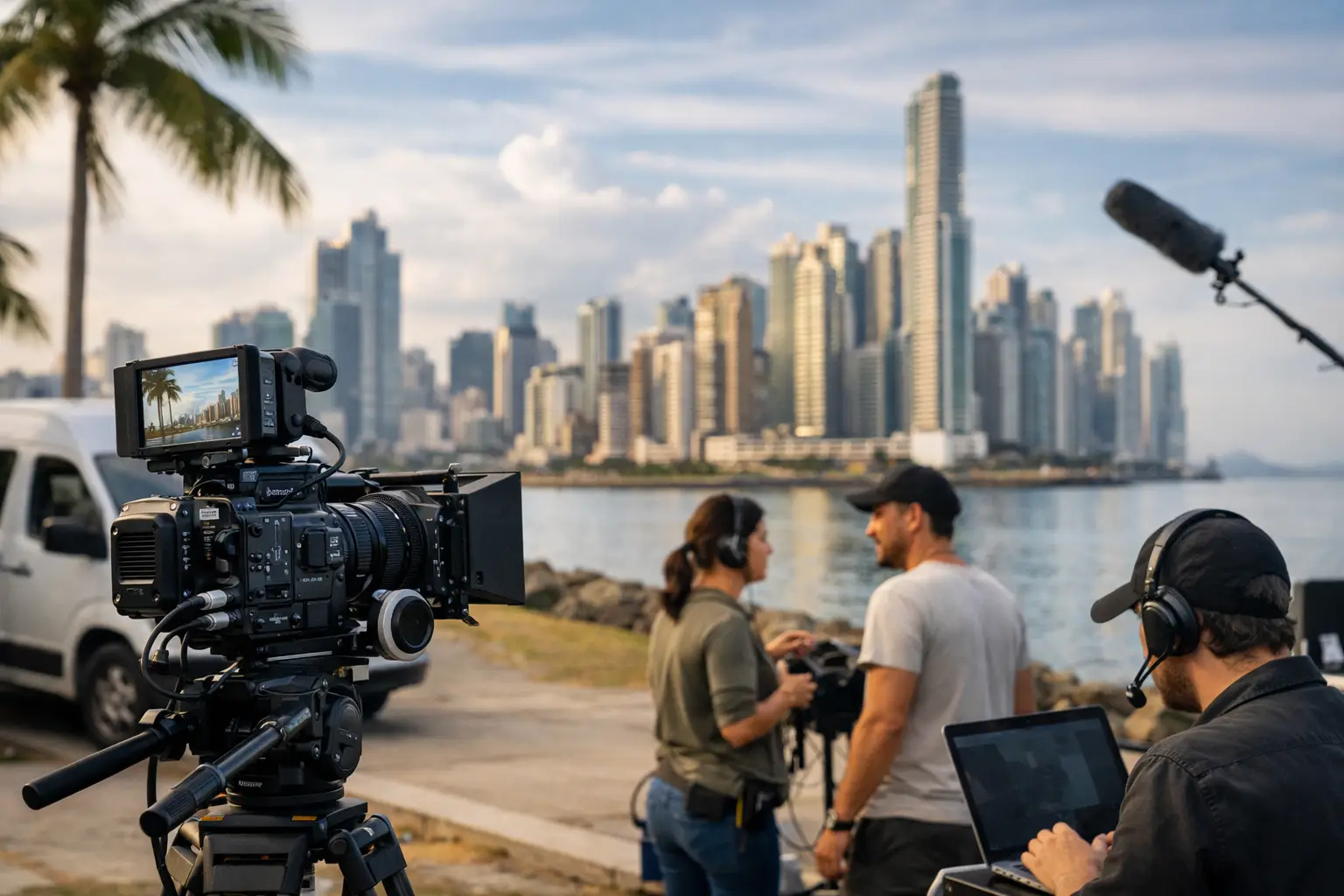
A Panama production services review should not begin with a location reel. It should begin with the production day that goes wrong: a permit is still pending, a cargo shipment is delayed, rain changes the plan, and a department needs a local solution before call time. The value of a production partner is measured in how well that situation is anticipated, communicated, and resolved.
For international producers, Panama can offer a highly efficient base for features, commercials, unscripted programming, branded content, and travel-led shoots. The country combines city infrastructure, tropical landscapes, coastlines, rainforest, islands, historic districts, and the Canal within manageable travel distances. But access to those advantages depends on the local team handling the work behind the camera with the same discipline as the work in front of it.
What a Panama Production Services Review Should Measure
The right local production company is not simply a fixer who can make calls. It should operate as a one-stop production partner with clear authority, dependable local relationships, realistic budgeting, and a working understanding of how international productions make decisions.
A useful review looks beyond a service list. Ask how the company builds a schedule, who owns each approval, how it vets crew and suppliers, and what happens when the plan changes. A capable team should be able to explain its process in practical production terms, not broad destination marketing language.
For a short commercial shoot, that may mean fast location options, bilingual production coordination, rental packages, transportation, catering, and permit tracking under a compressed preproduction timeline. For a feature or series, it may mean a deeper operating structure: department staffing, accommodation blocks, customs coordination, payroll, security, casting support, unit moves, and contingency planning across several weeks.
The scale of the job matters. So does the degree of control the visiting production needs to retain. Some producers need a local partner to execute a defined plan. Others need the local team to help build the plan from the first budget and recce. A production services company should be comfortable with both models and define responsibilities early.
Permits Are a Production-Critical Service
Panama offers exceptional filming opportunities, but permits are not a final paperwork task. They shape access, timing, crew size, parking, traffic control, drone operations, public-area use, protected locations, and municipal coordination. A strong local partner identifies these requirements before the schedule hardens.
This is especially relevant for shoots involving the Panama Canal area, historic districts, national parks, government-controlled spaces, airports, beaches, roads, or marine locations. Each environment can involve different authorities, lead times, insurance expectations, and operational restrictions. The most useful production services team will flag limitations during the location-scouting stage rather than presenting them as late-stage complications.
Producers should ask direct questions: Which permits are included in the estimate? Which costs are pass-through expenses? What lead times are realistic? Who communicates with authorities? What documentation must arrive from the foreign production? Clear answers protect both the schedule and the client relationship.
Drone filming deserves particular attention. Weather, airspace, proximity to sensitive sites, crew credentials, and local permissions can all affect whether an aerial plan is feasible. A professional partner does not promise every shot. It presents viable options, states the approval path, and prepares a ground-based alternative when needed.
Crew Depth Matters More Than a Directory
A local crew list has value only if it reflects current availability, department experience, language capability, and the demands of the format. Panama has experienced professionals across camera, grip, electric, art, wardrobe, makeup, production, sound, transportation, and location management. The practical question is whether the service company can assemble the right crew for the job and manage the working relationships around it.
International shoots often benefit from a mixed crew model. Key creative or technical positions may travel with the client, while Panama-based department teams provide local knowledge, labor support, equipment familiarity, and faster problem-solving. This can control travel costs without compromising the department structure required by the production.
Crew selection should also account for pace. A reality team moving across multiple regions needs a different local crew profile than a tabletop commercial, a scripted unit, or a high-security corporate shoot. The production partner should recommend staffing based on the actual shooting plan, not simply fill every role available.
At 40 Grados Producciones, the objective is to give visiting teams a local operating structure that feels accountable from prep through wrap. That means matching crews and suppliers to the production’s requirements while keeping communication direct, documented, and timely.
Locations Need to Be Assessed as Worksites
Panama’s visual range is a major production advantage. A crew can move from a modern skyline to colonial architecture, dense rainforest, Caribbean water, Pacific beaches, mountain communities, and industrial settings without building an itinerary across several countries. That range can reduce travel days and expand creative options.
Still, a beautiful location is not automatically a filmable one. Access roads, load-in routes, generator placement, holding areas, restrooms, signal coverage, rain cover, parking, nearby noise, tide conditions, and local community considerations all affect the real cost of a location. A detailed scout is where a production services partner earns its fee.
The best recce materials do more than provide photographs. They identify practical camera angles, sun direction, likely restrictions, nearby support areas, travel times, and backup choices. For remote or water-based locations, they should also address boats, safety personnel, weather windows, fuel, communications, and medical access.
It depends on the project whether the priority is visual variety or operational efficiency. A two-day campaign may need locations close to Panama City to protect the schedule. A travel series may justify longer company moves for a more distinctive story. A local partner should explain that trade-off before the client commits to a route.
Budget Control Is Built During Prep
Panama is often attractive because it can provide competitive costs compared with larger production hubs. That advantage is real only when the budget is built with local detail. International producers should expect a production services estimate to separate labor, equipment, locations, permits, transport, accommodation, freight, insurance, catering, and management costs in a way that supports approvals and cost reporting.
The lowest initial estimate is not necessarily the safest. Underbudgeted transportation, incomplete permit assumptions, unplanned overtime, and vague equipment allowances can create expensive changes later. A reliable partner asks enough questions to price the job accurately, including shooting hours, crew count, agency attendance, talent requirements, equipment specs, location complexity, and weather contingencies.
Currency, payment timing, local vendor terms, and tax treatment should also be discussed early. These are not glamorous preproduction topics, but they affect cash flow and final cost. Good service production keeps the client informed before a cost becomes a surprise.
The 25% Cash Rebate Requires Early Planning
Panama’s film incentive is one of the country’s strongest financial considerations for qualifying international productions. The potential 25% cash rebate can materially improve the economics of a project, but it should never be treated as an automatic discount on the first budget.
Eligibility, qualifying expenditures, application requirements, minimum spend thresholds, documentation, approval timing, and final audit procedures need to be reviewed before production commitments are made. The rebate may be highly relevant for a feature, series, or larger project, while a smaller commercial shoot may not meet the program’s criteria or timeline.
A knowledgeable production services company can help producers evaluate whether the incentive fits the project and organize the local documentation needed to pursue it. The right approach is conservative: budget the shoot on confirmed costs, then treat the incentive according to the applicable rules and approved pathway.
Communication Is the Real Test
International production is built on trust across time zones, departments, vendors, and decision-makers. The most effective local partners communicate with enough detail to keep a line producer comfortable and enough speed to keep a director or agency moving.
Before arrival, that means current budgets, permit status, crew confirmations, equipment plans, location updates, and clear decision deadlines. During the shoot, it means concise reporting, immediate escalation of real risks, and solutions that account for budget, safety, and creative intent. After wrap, it means organized wrap accounting and reliable follow-through on outstanding supplier matters.
A Panama production services review ultimately comes down to operational confidence. Can the local team turn a strong destination into a controlled, compliant, workable production? When the answer is yes, Panama is not just a place to shoot. It becomes a practical production choice for teams that want distinctive images without sacrificing command of the process.
The best next step is to share the real brief early – dates, format, crew size, locations, budget range, and any incentive expectations. A serious local partner can then tell you what is achievable, what needs adjustment, and where Panama can deliver the most value on screen and on the production report.