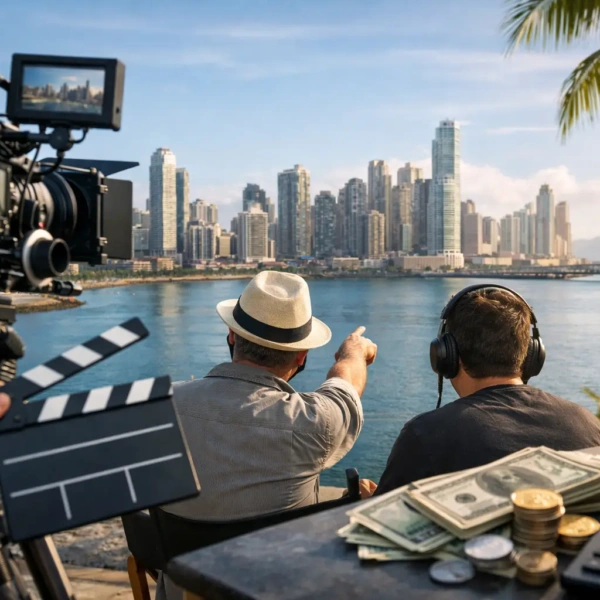

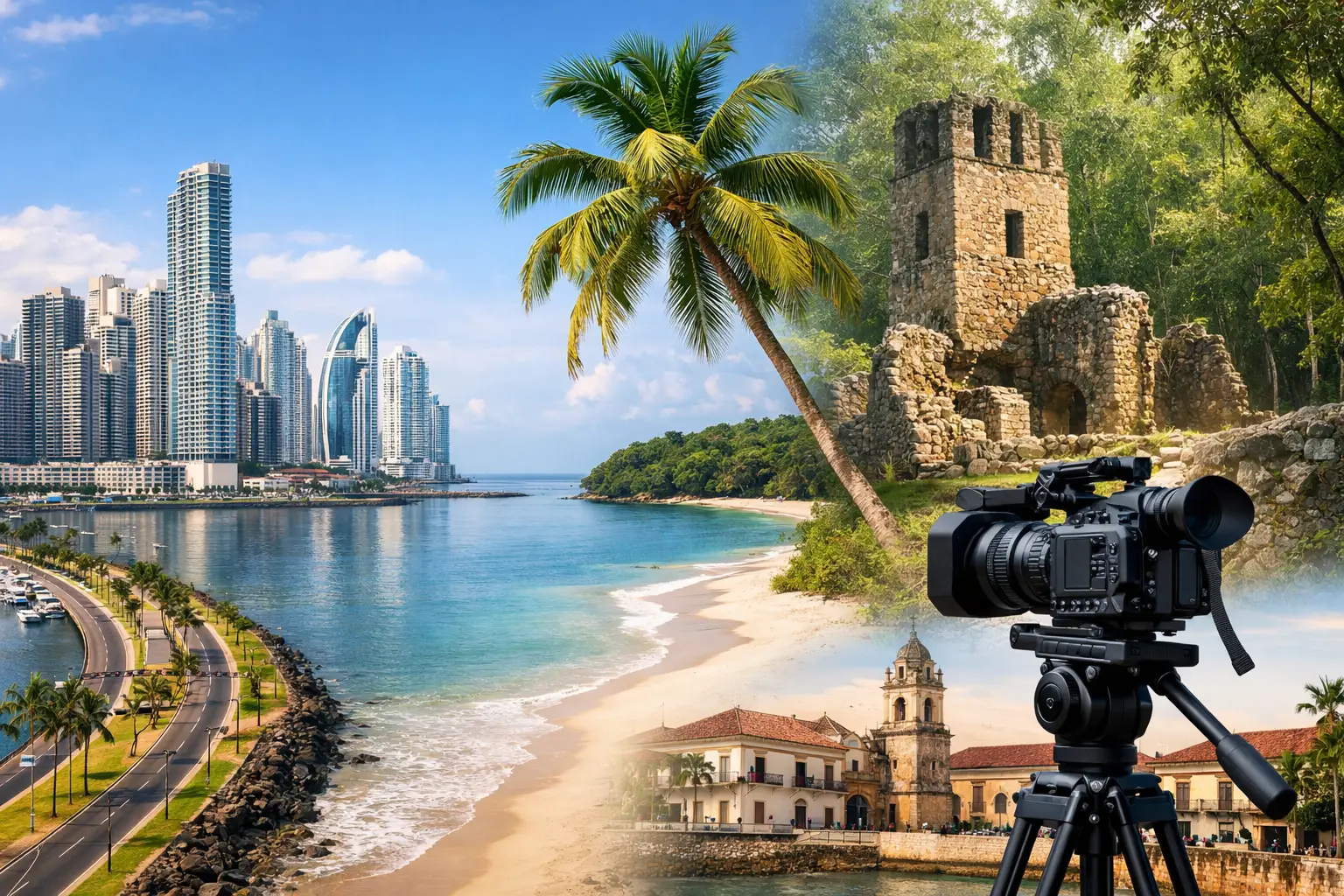
A morning call sheet can move from a colonial plaza to a glass-and-steel skyline, then finish on a jungle river before wrap. Few production destinations offer that range within workable travel time. For international teams comparing the best places to film in Panama, the value is not only visual variety. It is the ability to build a practical shooting plan around it – with local crew, equipment, permits, transport, and production support coordinated in country.
Panama can play contemporary Latin America, a tropical capital, a Caribbean island, a remote rainforest, or a period setting with minimal border crossings and fewer company moves than many regional alternatives. The right location depends on the script, access requirements, unit size, weather window, and the level of control the production needs.
Best Places to Film in Panama: 10 Production-Ready Options
1. Panama City skyline and waterfront
Panama City delivers a high-production-value urban look: towers, marinas, multilane roads, modern residences, business districts, and expansive views over Panama Bay. It is a strong choice for commercials, features, television, music videos, and branded content that need a contemporary international city without doubling for a generic North American downtown.
The Cinta Costera waterfront and surrounding skyline can provide wide establishing shots, lifestyle scenes, running footage, and vehicle work. Urban filming requires detailed traffic, public-space, drone, and crowd-control planning, particularly near major arteries. A local production team can assess the workable angle, holding area, access route, and permit path before a location is locked.
2. Casco Antiguo
Casco Antiguo gives productions cobblestone streets, restored colonial facades, balconies, plazas, churches, rooftop views, and a distinctive contrast between historic architecture and the modern skyline beyond it. It can support period storytelling, upscale travel campaigns, fashion work, intimate dramas, and destination content.
Its appeal comes with operational limits. Streets are narrow, public activity is constant, parking is restricted, and some properties have specific access rules. Smaller footprint units often work best here. For larger scenes, schedule, basecamp planning, neighborhood coordination, and a realistic equipment package make the difference between a beautiful shoot and a slow one.
3. The Panama Canal and canal-zone landscapes
The Panama Canal is one of the country’s most recognizable visual assets. Locks, vessels, industrial scale, tropical water, and surrounding forest create an immediate sense of movement and global commerce. It is especially valuable for documentaries, factual programming, corporate films, travel series, and stories centered on logistics, engineering, or maritime life.
Canal-related filming is not a walk-up location. Security requirements, authority approvals, restricted zones, crew lists, equipment declarations, and lead times must be treated as core production tasks. Nearby canal-zone areas can sometimes deliver complementary roads, forest edges, colonial-era buildings, and water views with more flexible logistics.
4. Soberanía National Park and the Chagres River
For jungle that is accessible from Panama City, Soberanía National Park is one of the most efficient options. Dense rainforest, wildlife, trails, rivers, and atmospheric canopy can be reached without committing the entire schedule to a remote expedition. The Chagres River adds a cinematic water element for boats, adventure formats, survival content, and conservation storytelling.
This is a strong choice when the brief calls for authentic tropical forest but the production still needs city-based accommodation, crew depth, and equipment access. Rain protection, waterproof cases, insect management, medical planning, and daylight discipline are essential. The rainforest is visually generous, but it will set its own pace.
5. San Blas and the Guna Yala coast
The Guna Yala region offers clear Caribbean water, small islands, palm-lined beaches, traditional boats, and a landscape that feels far removed from urban Panama. It is a premium location for travel programming, adventure work, fashion, resort-style campaigns, and documentary projects where the Caribbean needs to feel genuine rather than constructed.
The trade-off is access and sensitivity. Travel involves land and boat logistics, weather can alter the schedule, and local authorities and communities must be approached with respect and clear permissions. Productions should build in contingency time, travel light where possible, and avoid assumptions about power, connectivity, catering, or last-minute equipment replacement.
6. Bocas del Toro
Bocas del Toro provides another Caribbean production environment, with colorful island towns, surf breaks, mangroves, beaches, boats, and lush vegetation. Its relaxed visual language suits lifestyle content, music videos, reality programming, tourism campaigns, and water-based shoots.
Unlike a controlled studio beach, Bocas requires a location-driven plan. Boats are often part of the daily movement schedule, changing weather affects water work, and remote locations may limit heavy grip and electric packages. A scout should confirm dock access, tide conditions, power availability, noise concerns, and the time required to move cast, crew, and gear between islands.
7. Pearl Islands
For isolated beaches, private-island energy, open water, and polished luxury visuals, the Pearl Islands are a compelling option. The archipelago can support high-end commercials, reality formats, marine content, and scripted scenes where the location needs to feel exclusive and unspoiled.
Production decisions here start with marine logistics. Transport capacity, vessel safety, weather alternatives, communication plans, and overnight requirements need to be defined early. The best result usually comes from matching the creative ambition to the location’s operational reality instead of trying to force a large urban-style unit onto a remote island schedule.
8. Boquete and the Chiriquí Highlands
Boquete and the Chiriquí Highlands replace tropical heat with mountains, cloud forest, coffee farms, waterfalls, rolling roads, and cooler light. This region can play a Central American highland town, an eco-retreat, an agricultural setting, or a dramatic outdoor escape. It is particularly useful when a single Panama production needs visual contrast from coastal and city material.
Highland weather is more variable than many visiting teams expect. Mist, rain, and fast changes in visibility can be an asset for mood, but they require flexible coverage and a schedule that protects essential exterior scenes. Road access, crew travel, lodging capacity, and equipment transport should be scoped during preproduction rather than solved on the day.
9. Azuero Peninsula
The Azuero Peninsula offers a different Panama: rural roads, cattle country, traditional towns, open fields, beaches, and a strong cultural identity. It is a practical visual choice for documentaries, food and travel series, heritage storytelling, automotive work, and narratives that require a grounded, less metropolitan setting.
Azuero can also be valuable for productions looking for dry-season textures and wide-open space. However, it is not a substitute for Panama City’s production infrastructure. Crew, specialty equipment, accommodations, permits, and transport may need to travel in, so unit size and shooting efficiency should be planned around the actual location rather than its map distance.
10. Darién for true wilderness stories
Darién is Panama at its most remote and uncompromising: thick forest, rivers, Indigenous territories, and terrain that can serve serious documentary or expedition-based storytelling. It is not a general-purpose location, and that is exactly why it can be powerful on screen.
Projects here need rigorous risk assessment, permissions, experienced local coordination, medical and communications planning, and realistic expectations around access. For many commercial or scripted productions, Soberanía or another more accessible forest location will deliver the required look more efficiently. Darién is best reserved for projects whose story genuinely requires it.
Build the Location Plan Around Production Reality
A strong Panama location package is not simply a collection of beautiful reference images. It accounts for authority permits, private-property agreements, drone regulations, weather, driving time, unit moves, local labor rules, security, customs support, and contingency coverage. It should also identify where a location can carry multiple script needs, reducing company moves without reducing visual range.
Panama’s production incentive can add another layer of value. Qualifying international productions may be eligible for a 25% cash rebate, subject to the applicable program requirements, approvals, and eligible spend. Incentive planning should begin at budgeting stage, not after the schedule is set, because documentation and local expenditure structure matter.
40 Grados Producciones works with international producers to turn a location wish list into an executable plan: scouting, permits, crew, equipment, logistics, legal guidance, and on-the-ground management. The most effective next step is to share the script requirements, intended shoot dates, unit size, and reference imagery early. Panama has exceptional range, but the best location is the one that delivers the shot, protects the schedule, and stays under control when conditions change.